<?xml version="1.0" encoding="UTF-8"?>
<?xml-stylesheet type="text/xsl" href="/stylesheets/feed.atom.xml" media="screen"?>
<feed xml:lang="en-US" xmlns="http://www.w3.org/2005/Atom">
  <id>tag:classics.nd.edu,2005:/news-events/news</id>
  <link rel="alternate" type="text/html" href="https://classics.nd.edu"/>
  <link rel="self" type="application/atom+xml" href="https://classics.nd.edu/news-events/news.atom"/>
  <id>tag:classics.nd.edu,2005:/latest</id>
  <title>Department of Classics | News</title>
  <updated>2026-10-06T11:59:00-04:00</updated>
  <link rel="alternate" type="text/html" href="https://classics.nd.edu/"/>
  <link rel="self" type="application/atom+xml" href="https://classics.nd.edu//news-events/news.atom"/>
  <subtitle>Explore a compelling aspect of world history and culture. Uncover influential ideas that shaped civilizations and discover fascinating insights.</subtitle>
  <entry>
    <id>tag:classics.nd.edu,2005:News/186028</id>
    <published>2026-10-06T11:59:00-04:00</published>
    <updated>2026-10-06T14:15:02-04:00</updated>
    <link rel="alternate" type="text/html" href="https://classics.nd.edu/news-events/news/applications-open-for-classics-summer-2026-internships-at-rome-and-isthmia-due-oct-26-2026/"/>
    <title>Applications Open for Classics Summer 2027 Internships at Rome and Isthmia (Due Oct. 26, 2026)</title>
    <summary type="text">
      <![CDATA[We invite you to apply for our fully funded summer internships in Rome and Isthmia, Greece. The application deadline is Monday, October 26, 2026. Our successful applicants will be notified within 2 weeks and then invited to apply as Classicists for the …]]>
    </summary>
    <content type="html">
      <![CDATA[<p>We invite you to apply for our fully funded summer internships in Rome and Isthmia, Greece. The application deadline is Monday, October 26, 2026. Our successful applicants will be notified within 2 weeks and then invited to apply as Classicists for the <a href="https://ndi-sa.nd.edu/index.cfm?FuseAction=Programs.ViewProgramAngular&amp;id=10121" target="_blank" data-saferedirecturl="https://www.google.com/url?q=https://ndi-sa.nd.edu/index.cfm?FuseAction%3DPrograms.ViewProgramAngular%26id%3D10121&amp;source=gmail&amp;ust=1759626955736000&amp;usg=AOvVaw0y_IJCz4Jc3wK7URmKroZY" rel="noopener">Summer Keough GPE Program</a> before their November 15, 2026 deadline.</p>
<p>Rome: May 18- July 10, 2027</p>
<p>We are currently working with host institutions in Rome to determine exactly which internships will be available. Since the word is now spreading about how wonderful our Classics majors are, we hope to add even more internship experiences in Rome. We will keep you posted on developments and details. Rome interns normally work for about 20 hours per week and are supported by Notre Dame Rome.</p>
<p>Isthmia: <em>circa</em> June 15 to July 15, 2027</p>
<p>Interns in Isthmia will be under the supervision of Prof. Alessandro Pierattini (of ND's School of Architecture).</p>
<p><strong>Examples of Previous Summer Internships through ND Rome</strong></p>
<p>I) <a href="https://www.unigre.it/en/" target="_blank" data-saferedirecturl="https://www.google.com/url?q=https://www.unigre.it/en/&amp;source=gmail&amp;ust=1759626955736000&amp;usg=AOvVaw1nArz2HmTH1UAMYHPjmPPf" rel="noopener"><strong>Gregorian University</strong></a></p>
<p>Student interns transcribed original manuscripts from the <a href="https://www.unigre.it/en/historical-archive/" target="_blank" data-saferedirecturl="https://www.google.com/url?q=https://www.unigre.it/en/historical-archive/&amp;source=gmail&amp;ust=1759626955736000&amp;usg=AOvVaw2D2PWLZYthoN7424y7w2qe" rel="noopener">historical archive</a>.</p>
<p>Latin required; knowledge of Italian, French or Spanish is desirable.</p>
<p>“The Archive owns a precious heritage which attests the intellectual activity of the Roman College's Jesuits, from its foundation in 1551 until the suppression of the Society of Jesus, which occurred in 1773. After the suppression of the Society of Jesus in 1773, it has been buried and walled up. Once brought to light from its hiding place, in 1878 it has been placed in a mansard of the Roman College, then the seat of the incipient NATIONAL CENTRAL LIBRARY OF ROME. More than 5,000 manuscripts prove the lessons of rhetoric, grammar, philosophy and theology, delivered over the course of two centuries, as well as the study on Greek and Latin classics, astronomy, mathematics, physics and languages such as Latin, Greek, Hebrew and Arabic.”</p>
<p>II) <a href="https://www.aarome.org/" target="_blank" data-saferedirecturl="https://www.google.com/url?q=https://www.aarome.org/&amp;source=gmail&amp;ust=1759626955736000&amp;usg=AOvVaw23Opi60B9Dq1JSo9HDCefx" rel="noopener"><strong>American Academy in Rome</strong></a></p>
<p>Student interns have catalogued and digitalized images from the Academy's renowned research <a href="https://www.aarome.org/research/library/about" target="_blank" data-saferedirecturl="https://www.google.com/url?q=https://www.aarome.org/research/library/about&amp;source=gmail&amp;ust=1759626955736000&amp;usg=AOvVaw2xeNTHrc3K9PVYo1IDDD1F" rel="noopener">Library</a>, which includes an extensive collection of material artifacts.</p>
<p>“The Arthur &amp; Janet C. Ross Library contains 172,000 volumes in the fields of classical studies and the history of art and architecture (chiefly Italian, medieval, and Renaissance) with strong collections in ancient Mediterranean art and archaeology, classical literature, ancient topography—including the history of the city of Rome—and related fields such as epigraphy, numismatics, and papyrology.”</p>
<p>III) <a href="https://bibliotecaangelica.cultura.gov.it/" target="_blank" data-saferedirecturl="https://www.google.com/url?q=https://bibliotecaangelica.cultura.gov.it/&amp;source=gmail&amp;ust=1759626955736000&amp;usg=AOvVaw2TANb02EBuvhGwHu1z5J40" rel="noopener"><strong>Biblioteca Angelica</strong></a></p>
<p>Intermediate-Advanced Italian required.</p>
<p>The Biblioteca has sought interns to translate the website from Italian into English, lead groups of visitors (in English), learn how to catalogue volumes and digitalize the archive, partake in didactive activities and provide library assistance to visiting scholars.</p>
<p><strong>Archaeology in </strong><a href="https://lucian.uchicago.edu/blogs/isthmia/" target="_blank" data-saferedirecturl="https://www.google.com/url?q=https://lucian.uchicago.edu/blogs/isthmia/&amp;source=gmail&amp;ust=1759626955736000&amp;usg=AOvVaw234chPzBrV_5QTmYEhAhwU" rel="noopener"><strong>Isthmia</strong></a></p>
<p><em>circa</em> June 21 - July 15, 2026</p>
<p>About 30-35 hours of work per week. No language requirement.</p>
<p>Situated near Corinth, Isthmia is located at a very strategic location and hosted the <a href="https://warwick.ac.uk/fac/arts/classics/intranets/students/modules/greekreligion/database/clunay/" target="_blank" data-saferedirecturl="https://www.google.com/url?q=https://warwick.ac.uk/fac/arts/classics/intranets/students/modules/greekreligion/database/clunay/&amp;source=gmail&amp;ust=1759626955736000&amp;usg=AOvVaw2M_QXKCZo128jCdrXq5TfQ" rel="noopener">Sanctuary of Poseidon</a>. This was one of the four sanctuaries where Greeks from all over the Mediterranean came to celebrate Pan-Hellenic games. Student interns will work with archaeological artifacts (pottery, coins, bones, etc.) found in Isthmia under the supervision of Prof. Alessandro Pierattini (of ND's School of Architecture) and Jean Perras. Duties may include mending, washing, photographing and shelving artifacts; managing excavation data and organizing archival files and labels; and scanning records and inserting data. Organized field trips take students to important historical sights, especially within the Peloponnesus.</p>
<p><u>FUNDING</u></p>
<p>Interns will receive full funding to cover the costs of insurance, housing, food, miscellaneous expenses, and organized field trips (as available). Logistical support and funding have been generously provided by the Department of Classics' McNulty Fund, the Keough/Nanovic Institutes, ND Rome, and the Center for the Study of Languages and Cultures. Students will normally arrange and pay for their own travel to and from their destinations, but if you have financial concerns after you are accepted, please see either Profs Luca Grillo or Mary McNulty.</p>
<p><u>ELIGIBILITY</u><br>We will consider applications from ND Classics majors and minors.</p>
<p>Graduating seniors are not eligible.</p>
<p><u>APPLICATION</u></p>
<p>To apply, please fill out <a href="https://docs.google.com/forms/d/e/1FAIpQLSeYD55itt9NZhF82nhK91Ey3IKhYzoCTVBc8eTCEvIjZCD44A/viewform" data-saferedirecturl="https://www.google.com/url?q=https://docs.google.com/forms/d/e/1FAIpQLScHktVSIbBj2wNn5yk55jFGbaK-vgc1zP54lbah1W7A702_1Q/viewform?usp%3Dheader&amp;source=gmail&amp;ust=1759626955736000&amp;usg=AOvVaw2CKLUxi96ftR9QdHjhTlkn">this form</a>.<br>Application deadline: October 26, 2026.<br><br>If you have any questions, please contact Prof Luca Grillo (<a href="mailto:lgrillo@nd.edu" target="_blank" rel="noopener">lgrillo@nd.edu</a>) or Prof Mary McNulty (<a href="mailto:mmcnulty@nd.edu">mmcnulty@nd.edu</a>)</p>]]>
    </content>
    <link rel="enclosure" type="image/jpeg" href="https://classics.nd.edu/assets/203978/rome_nd_classics_900_x_225.jpg" title="rome_nd_classics_900_x_225.jpg"/>
    <author>
      <name>Chelsea Cloutier</name>
    </author>
  </entry>
  <entry>
    <id>tag:classics.nd.edu,2005:News/184640</id>
    <published>2026-07-27T11:42:00-04:00</published>
    <updated>2026-08-10T11:42:43-04:00</updated>
    <link rel="alternate" type="text/html" href="https://classics.nd.edu/news-events/news/renowned-latinist-prof-sergio-casali-joining-notre-dame-classics-this-fall-to-teach-virgil/"/>
    <title>Renowned Latinist Prof. Sergio Casali Joining Notre Dame Classics This Fall to Teach Virgil</title>
    <summary type="text">
      <![CDATA[The Department of Classics is thrilled to welcome Professor Sergio Casali as a Visiting Professor for the Fall 2026 semester! Prof. Casali—Full Professor of Latin Language and Literature at the University of Rome Tor Vergata—is widely recognized as one of the world’s foremost…]]>
    </summary>
    <content type="html">
      <![CDATA[<p>The Department of Classics is thrilled to welcome<strong> </strong>Professor Sergio Casali as a Visiting Professor for the Fall 2026 semester!</p>
<p>Prof. Casali—Full Professor of Latin Language and Literature at the University of Rome Tor Vergata—is widely recognized as one of the world’s foremost authorities on Latin poetry, specifically Virgil and Ovid. His leadership in the field includes serving as the President-Elect of the Vergilian Society (2026–2029) and Co-Chair of the International Ovidian Society (2026–2027).</p>
<p>His extensive contributions to classical scholarship have earned him prestigious global recognitions, including the 2019 Alexander G. McKay Prize for Vergilian Studies for his seminal commentary <em data-path-to-node="5" data-index-in-node="195">Virgilio, Eneide 2</em> (Edizioni della Normale), as well as the International "Vergilius" Prize from the Accademia Virgiliana di Mantova.</p>
<h3 data-path-to-node="6"><strong data-path-to-node="6" data-index-in-node="0">Fall 2026 Course Spotlight: Virgil</strong></h3>
<p>This fall, Notre Dame undergraduate and graduate students have a rare opportunity to study Virgil under one of the premier Virgil scholars of our time:</p>
<ul data-path-to-node="8">
<li>
<p><strong data-path-to-node="8,0,0" data-index-in-node="0">Course:</strong> Virgil (CLLA 40031 / CLLA 60031)</p>
</li>
<li>
<p><strong data-path-to-node="8,1,0" data-index-in-node="0">Days &amp; Time:</strong> Mondays &amp; Wednesdays, 3:30 PM – 4:45 PM</p>
</li>
<li>
<p><strong data-path-to-node="8,2,0" data-index-in-node="0">Location:</strong> 209 O'Shaughnessy Hall</p>
</li>
</ul>
<p>Students in this course will gain unprecedented insight into Roman epic poetry from a master of Latin philology.</p>
<p>We invite the entire Notre Dame community to give Professor Casali a warm welcome to campus!</p>]]>
    </content>
    <link rel="enclosure" type="image/jpeg" href="https://classics.nd.edu/assets/665139/photo_casali.jpeg" title="Smiling man with gray curly hair, beard, tortoise-shell glasses, green jacket, near ocean cliffs."/>
    <author>
      <name>Chelsea Cloutier</name>
    </author>
  </entry>
  <entry>
    <id>tag:classics.nd.edu,2005:News/181821</id>
    <published>2026-05-18T13:19:00-04:00</published>
    <updated>2026-05-18T15:46:39-04:00</updated>
    <link rel="alternate" type="text/html" href="https://classics.nd.edu/news-events/news/professor-erynn-kim-selected-as-a-recipient-of-harvard-universitys-loeb-classical-library-foundation-fellowship-and-as-a-fellow-in-hellenic-studies-at-harvards-center-for-hellenic-studies-2/"/>
    <title>Professor Erynn Kim Receives Fellowships from Harvard University's Center for Hellenic Studies and Loeb Classical Library Foundation</title>
    <summary type="text">
      <![CDATA[Professor Erynn Kim of the Department of Classics has been selected as a Fellow in Hellenic Studies at Harvard University’s Center for Hellenic Studies (CHS) and as a recipient of Harvard&#39;s Loeb Classical Library Foundation…]]>
    </summary>
    <content type="html">
      <![CDATA[<p>Professor Erynn Kim of the Department of Classics has been selected as a <a href="https://chs.harvard.edu/meet-the-2026-27-fellows-in-hellenic-studies/">Fellow in Hellenic Studies at Harvard University’s Center for Hellenic Studies</a> (CHS) and as a recipient of Harvard's Loeb Classical Library Foundation Fellowship for the 2026-27 academic year.</p>
<p><br>The Center for Hellenic Studies residential fellowship fosters interaction among a diverse, international body of scholars to encourage high-quality research on topics related to ancient Greece. The Loeb Classical Library Foundation awards fellowships to support projects in classical studies. Professor Kim will hold her CHS residency in Fall 2026 and will use both fellowships to complete her monograph, entitled <em>The Poetics of Vividness: Dreams and Similes in Gilgamesh and Homer</em>.</p>
<p><br>Using the theoretical frameworks of narratology and cognitive studies, this book argues that the perceived vividness of <em>Gilgamesh</em> and the Homeric epics emerges not only from ekphrastic or immersive passages, as recent studies suggest, but also from dreams and similes, which interrupt the primary narrative. Comparing the dreams in <em>Gilgamesh</em> with Homeric similes, rather than “like” with “like,” this study focuses on poetics to advance ongoing efforts to define what constitutes a parallel and what distinguishes an “epic.” This project breaks new ground by arguing that the Greek and Babylonian traditions not only exhibit shared formal features of the epic genre but, significantly, converge in the way they engage their audiences in the storytelling process.</p>
<p><br>This book aims to invigorate scholarly discussions by facilitating interdisciplinary conversations across Classics, Near Eastern Studies, and Comparative Literature. Through her research, Professor Kim hopes to deepen our appreciation of the ancient world by drawing Classics into conversation with texts which, despite lying outside of the Greco-Roman canon, have contributed to shaping key works within it.</p>]]>
    </content>
    <link rel="enclosure" type="image/jpeg" href="https://classics.nd.edu/assets/660020/ek_photo_1_.jpeg" title="Professor Erynn Kim"/>
    <author>
      <name>Kelly Huth</name>
    </author>
  </entry>
  <entry>
    <id>tag:classics.nd.edu,2005:News/181275</id>
    <published>2026-04-30T12:11:00-04:00</published>
    <updated>2026-04-30T12:11:52-04:00</updated>
    <link rel="alternate" type="text/html" href="https://classics.nd.edu/news-events/news/professor-christopher-baron-receives-summer-fellowship-at-the-national-humanities-center/"/>
    <title>Professor Christopher Baron Receives Summer Fellowship at the National Humanities Center</title>
    <summary type="text">
      <![CDATA[Professor Christopher Baron of the Department of Classics has been selected to participate in the Scholarly…]]>
    </summary>
    <content type="html">
      <![CDATA[<p>Professor <a href="https://classics.nd.edu/people/faculty/christopher-baron/">Christopher Baron</a> of the Department of Classics has been selected to participate in the <a href="https://nationalhumanitiescenter.org/education-programs/faculty-programs/national-humanities-center-scholarly-writing-institute-2026/">Scholarly Writing Institute at the National Humanities Center </a>this summer.</p>
<figure class="image image-right"><img src="https://classics.nd.edu/assets/415052/baron_preferred_1200.jpg" alt="Baron Preferred 1200"></figure>
<p>The Scholarly Writing Institute is a 9-day writing-intensive workshop granting scholars dedicated time to focus on their research alongside their cohort of fellows from interdisciplinary humanities fields. Scholars have the opportunity to receive mentorship from a professional writing coach, collaborate with their cohort in group writing sessions, and consult with editors from respected academic presses. The program fosters a supportive community to encourage intellectual exchange among participants.</p>
<p>Professor Baron will dedicate this time to his current book project, <em>Greek Historians Under the Roman Empire</em>. Divided into seven chapters, each highlighting a different historian under Roman rule, Baron's book seeks to answer the question of what it means to write a history in Greek, within a tradition spanning back several centuries to Herodotus and Thucydides, while living as a subject of the Roman Empire. Does the power of Rome affect the historians' views of the past? How does Greek culture change under Roman rule?</p>
<p>Baron specifically hopes to make major progress in his chapter on Josephus, a Jewish priest who initially fought against Rome in the Jewish Revolt and witnessed the destruction of Jerusalem in 70 A.D. before later becoming a Roman citizen. Informed by the course he taught this past semester, "Josephus and Greek Historiography," Baron analyzes the manner in which Josephus chronicles the events of the Jewish Revolt in <em>Bellum Judaicum </em>(<em>The Jewish War</em>), written in Greek. Josephus may have become a Roman citizen, but did he really become Roman?</p>
<p>The award was made possible by a nomination from the <a href="https://franco.nd.edu/">Franco Family Institute for Liberal Arts and the Public Good</a>. The University of Notre Dame is an institutional sponsor of the National Humanities Center.</p>]]>
    </content>
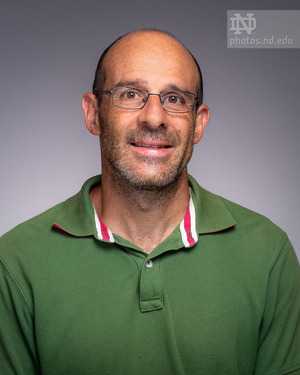
    <link rel="enclosure" type="image/jpeg" href="https://classics.nd.edu/assets/631379/christopher_baron_headshot.jpg" title="Headshot of a man with glasses, a salt-and-pepper beard, wearing a light blue checked shirt and a peach-colored tie, smiling against a gray background."/>
    <author>
      <name>Tommy Marino</name>
    </author>
  </entry>
  <entry>
    <id>tag:classics.nd.edu,2005:News/176817</id>
    <published>2025-11-24T12:19:00-05:00</published>
    <updated>2025-11-24T14:04:33-05:00</updated>
    <link rel="alternate" type="text/html" href="https://classics.nd.edu/news-events/news/introducing-the-new-m-a-track-in-classical-archaeology-2/"/>
    <title>Introducing the New M.A. Track in Classical Archaeology</title>
    <summary type="text">
      <![CDATA[We are thrilled to announce a new addition to our M.A. in Classics program: The M.A. Track in Classical Archaeology! If your passion lies at the intersection of Classical Studies and Archaeology, this is the moment…]]>
    </summary>
    <content type="html">
      <![CDATA[<p>We are thrilled to announce a new addition to our M.A. in Classics program: <a href="https://classics.nd.edu/graduate/m-a-in-classics/m-a-track-in-classical-archaeology/">The M.A. Track in Classical Archaeology</a>!</p>
<p>If your passion lies at the intersection of Classical Studies and Archaeology, this is the moment you've been waiting for. Please note that you can apply to this specialized track even if you demonstrate proficiency in<strong> just one</strong> of the core languages: Ancient Greek or Latin.</p>
<p>OFFICIAL ONLINE LAUNCH EVENT!<br>Join us for an exclusive Zoom launch to get all your questions answered!</p>
<ul>
<li>Date &amp; Time: Thursday, December 17th, at 3:30 PM (EST)</li>
<li>Featuring  Professor Aldo Tagliabue (Director of Graduate Studies) and Professor David Hernandez (Archaeologist who specializes in the material culture of the ancient Mediterranean Archaeology)</li>
</ul>
<p>If you are considering applying for the upcoming cycle (with a January 15th deadline), you must check out this new opportunity!</p>
<p>To RSVP for the launch event, please email Professor Tagliabue: atagliab@nd.edu</p>]]>
    </content>
    <link rel="enclosure" type="image/jpeg" href="https://classics.nd.edu/assets/639654/20240926_jlh_classics_david_hernandez_class_015_3_2.jpg" title="A man in a blue shirt unrolls large plans as six students watch intently in a classroom. A surveying tripod with a level stands nearby."/>
    <author>
      <name>Tommy Marino</name>
    </author>
  </entry>
  <entry>
    <id>tag:classics.nd.edu,2005:News/176377</id>
    <published>2025-11-07T16:05:10-05:00</published>
    <updated>2025-11-07T16:05:34-05:00</updated>
    <link rel="alternate" type="text/html" href="https://classics.nd.edu/news-events/news/classics-club-semi-annual-bonfire/"/>
    <title>Classics Club Semi-Annual Bonfire</title>
    <summary type="text">
      <![CDATA[Friday, October 17th, undergraduate and graduate students attended a bonfire and Trojan horse-burning at Holy Cross Hill hosted by the Classics Club. The Classics Club hosts a semi-annual bonfire on the evening before Notre Dame’s football match with rival USC, whose mascot is the Trojans.…]]>
    </summary>
    <content type="html">
      <![CDATA[<p>Friday, October 17th, undergraduate and graduate students attended a bonfire and Trojan horse-burning at Holy Cross Hill hosted by the Classics Club.</p>
<p>The Classics Club hosts a semi-annual bonfire on the evening before Notre Dame’s football match with rival USC, whose mascot is the Trojans. This year, the bonfire also provided students with an opportunity to celebrate their first half of the semester and upcoming fall break, making for a memorable and fun social experience for Classics students outside of class.</p>
<p>Future Classics Club events include their upcoming Saturnalia holiday party on Tuesday, December 9th.</p>
<figure class="image image-left"><img src="https://classics.nd.edu/assets/637758/classics_2025_usc_bonfire.webp" alt="A large bonfire, built from wooden pallets, burns intensely at night. Bright white and orange flames with sparks rise above dense smoke. Trees are visible in the dark background." width="550" height="423">
<figcaption>The Classics Club's Bonfire burning brightly the night before the USC game.</figcaption>
</figure>]]>
    </content>
    <link rel="enclosure" type="image/webp" href="https://classics.nd.edu/assets/637758/classics_2025_usc_bonfire.webp" title="A large bonfire, built from wooden pallets, burns intensely at night. Bright white and orange flames with sparks rise above dense smoke. Trees are visible in the dark background."/>
    <author>
      <name>Evan Birks</name>
    </author>
  </entry>
  <entry>
    <id>tag:classics.nd.edu,2005:News/176173</id>
    <published>2025-10-30T10:03:49-04:00</published>
    <updated>2025-10-30T10:22:14-04:00</updated>
    <link rel="alternate" type="text/html" href="https://classics.nd.edu/news-events/news/a-classicist-in-the-lab-how-studying-the-humanities-helps-me-succeed-as-a-biology-phd-student/"/>
    <title>A Classicist in the Lab: How Studying the Humanities Helps Me Succeed as a Biology PhD Student</title>
    <summary type="text">
      <![CDATA[I have never studied the classics with any intention of gleaning directly applicable information for my work in the sciences. Nevertheless, I have increasingly found that my continued engagement with classical studies as an academic discipline has imbued me with many of the basic skills I use as a scientist.]]>
    </summary>
    <content type="html">
      <![CDATA[<p>A common question I encounter when I reveal to someone that I study both infectious diseases and classical languages (Latin and Ancient Greek) is “why?”. The inquiry comes in the context of trying to understand how knowing Latin or Ancient Greek could possibly be useful to someone who works in a scientific field. I’ve been asked if I want to learn Latin (and later Greek) as part of preparation for medical school or because many scientific names and terms are derived from one of these languages.</p>
<p>The underlying belief behind these questions is that I am only studying languages because they must be useful to my scientific career. I have never studied the classics with any intention of gleaning directly applicable information for my work in the sciences. Nevertheless, I have increasingly found that my continued engagement with classical studies as an academic discipline has imbued me with many of the basic skills I use as a scientist. So, here are the skills I learned as a classicist that I now use as I build my scientific career:</p>
<h3>How to craft a data driven argument</h3>
<p>In college, I was frequently tasked with writing lab reports based on data generated from an in-class exercise. These lab reports were meant to prepare us to write data driven arguments in our future lives, yet I struggled to see how they were useful. Many of the experiments done in class had known “correct” answers. Because the intended conclusion was obvious, I struggled to learn how to draw conclusions from the data independent of the outcome I knew I was supposed to get. It wasn’t until I started working on my senior thesis in Classics that I understood how a data driven argument was meant to be constructed.</p>
<p>I started by investigating the influence of social media on modern perceptions of the gorgon Medusa. I recorded information posted about her on Reddit and TikTok. I wanted to know what the average internet denizen thought about Medusa (what she looked like, what her story was, etc.) and how they were using her in their own narratives (as a sex object, a lesbian, etc). Concurrently, I also researched her representation in the ancient sources, asking the same questions of the Ancient Greek and Latin texts which I was asking of the social media sources. At the end of the research phase, I was inundated with data, examples of different narratives and uses, both modern and ancient, of the character. For the first time, I had to write without having a known answer in mind.</p>
<p>As I incorporated more data into the study, I found that the argument I had originally crafted, namely that social media users in their reception of Medusa would either reproduce her exactly as she was in the ancient sources or would reject her ancient narrative entirely and craft something new, was constantly becoming more nuanced. I found that the modern receptions were defined not by strict adherence or divergence from the ancient sources, but rather by recrafting of the narrative of a few favorite sources (mostly Ovid) to create a Medusa whose narrative and iconography was influenced as much by the ancient sources as by previous receptions (e.g. by feminists of the 1960s) and the receptions of other users online. Completing the work showed me how to draw conclusions from the data and to guard against assumptions that might cause me to dismiss evidence.</p>
<h3>How to engage with an academic speaker</h3>
<p>When I started attending scientific seminars in graduate school, I quickly realized that, although I would listen to the talk, when Q&amp;A rolled around, I struggled to ask questions. The complex questions that the professors, post docs, and senior graduate students asked made me believe that I had to be a partial expert in order to ask a question.</p>
<p>Simultaneously, I also started attending seminars hosted by the Classical Studies department. The contrast between the two venues was stark. Whereas the scientific seminars tended to focus on presenting data and defending conclusions, many of the Classical Studies presentations were more like workshops. The speaker would read the essay they had prepared for the occasion, sometimes accompanied by slides, with the expectation that the audience would contribute to the revision of their ideas. Even though my Classics research interests are focused on Classical reception (the study of how concepts and texts from the Classical Greco-Roman world are used and adapted), I found that I was still able to contribute to discussions about history and medieval studies.</p>
<p>By drawing on my existing knowledge of classical texts and principles, I was able to practice the sort of lateral thinking that allows an entomologist to stand up at a neuroscience lecture to ask about the function of a particular gene. This has helped me gain confidence that I can perform similar associations the next time I am sitting in a biology department seminar.</p>
<h3>How to explain scientific concepts beyond an academic context</h3>
<p>A major barrier to successful communication is a language barrier between the speaker (typically a researcher or academic) and the audience, which may contain experts in the field, fellow academics in other disciplines, students or members of the public. Effective communication happens when you know your audience and tailor your presentation to foster understanding to that specific audience. This can be difficult after one spends years in a field and grows accustomed to the lexicon and speaking to a unified scientific audience.</p>
<p>In a broader sense, we can view the problem of academic communication as an extension of the issue of translation. In translation, the goal is to bridge a gap of understanding between groups of people who speak different languages. While translation is an exercise I frequently encounter in my Classics studies, I did not fully appreciate how useful the exercise would be for improving my science communication skills until I encountered a knowledge gap problem while I was working on a Greek composition project.</p>
<p>My narrative included an encounter with a horde of zombies, and I quickly realized when I got to that section of my writing that an Ancient Greek person would have had no idea what a zombie is. In order to complete my composition, I had to think concretely about what a zombie fundamentally is and what ideas already existed in my target language to convey that idea. Through this exercise I understood the importance of assessing the audience’s knowledge of my subject matter and using their knowledge base as a guiding lens through which to view presentation and communication.</p>
<p>Now that I’m a graduate student, I reflect on how studying in the humanities benefits me, as a researcher, in indirect but tangible ways. The narrative sold to and perpetuated by students, that only subjects which directly relate to their intended field of study are valuable, is false. My advice now? Go forth and learn widely - you never know what will prove useful in your future.</p>]]>
    </content>
    <link rel="enclosure" type="image/jpeg" href="https://classics.nd.edu/assets/636582/lab_photo.jpg" title="A smiling young woman in a white lab coat and black gloves gives a thumbs-up in a science laboratory. Shelves filled with lab supplies and various equipment like pipettes and a centrifuge are visible around her."/>
    <author>
      <name>Stephanie Morgan, PhD Candidate in Biology at Notre Dame</name>
    </author>
  </entry>
  <entry>
    <id>tag:classics.nd.edu,2005:News/175499</id>
    <published>2025-10-03T22:37:00-04:00</published>
    <updated>2025-10-08T08:57:02-04:00</updated>
    <link rel="alternate" type="text/html" href="https://classics.nd.edu/news-events/news/applications-open-for-classics-summer-2026-internships-at-rome-and-isthmia-due-nov-1-2025/"/>
    <title>Applications Open for Classics Summer 2026 Internships at Rome and Isthmia (Due Nov. 1, 2025)</title>
    <summary type="text">
      <![CDATA[We invite you to apply for our fully funded summer internships in Rome and Isthmia, Greece. The application deadline is Saturday Nov 1, 2025. Our successful applicants will be notified within 2 weeks and then invited to apply as Classicists for the …]]>
    </summary>
    <content type="html">
      <![CDATA[<p>We invite you to apply for our fully funded summer internships in Rome and Isthmia, Greece. The application deadline is Saturday Nov 1, 2025. Our successful applicants will be notified within 2 weeks and then invited to apply as Classicists for the <a href="https://ndi-sa.nd.edu/index.cfm?FuseAction=Programs.ViewProgramAngular&amp;id=10121" target="_blank" data-saferedirecturl="https://www.google.com/url?q=https://ndi-sa.nd.edu/index.cfm?FuseAction%3DPrograms.ViewProgramAngular%26id%3D10121&amp;source=gmail&amp;ust=1759626955736000&amp;usg=AOvVaw0y_IJCz4Jc3wK7URmKroZY" rel="noopener">Summer Keough GPE Program</a> before their November 15, 2025 deadline.</p>
<p>Rome: <em>circa</em> May 20 to July 11, 2026</p>
<p>We are currently working with host institutions in Rome to determine exactly which internships will be available. Since the word is now spreading about how wonderful our Classics majors are, we hope to add even more internship experiences in Rome. We will keep you posted on developments and details. Rome interns normally work for about 20 hours per week and are supported by Notre Dame Rome.</p>
<p>Isthmia: <em>circa</em> June 21 to July 15, 2026</p>
<p>Interns in Isthmia will be under the supervision of Prof. Alessandro Pierattini (of ND's School of Architecture).</p>
<p><strong>Examples of Previous Summer Internships through ND Rome</strong></p>
<p>I) <a href="https://www.unigre.it/en/" target="_blank" data-saferedirecturl="https://www.google.com/url?q=https://www.unigre.it/en/&amp;source=gmail&amp;ust=1759626955736000&amp;usg=AOvVaw1nArz2HmTH1UAMYHPjmPPf" rel="noopener"><strong>Gregorian University</strong></a></p>
<p>Student interns transcribed original manuscripts from the <a href="https://www.unigre.it/en/historical-archive/" target="_blank" data-saferedirecturl="https://www.google.com/url?q=https://www.unigre.it/en/historical-archive/&amp;source=gmail&amp;ust=1759626955736000&amp;usg=AOvVaw2D2PWLZYthoN7424y7w2qe" rel="noopener">historical archive</a>.</p>
<p>Latin required; knowledge of Italian, French or Spanish is desirable.</p>
<p>“The Archive owns a precious heritage which attests the intellectual activity of the Roman College's Jesuits, from its foundation in 1551 until the suppression of the Society of Jesus, which occurred in 1773. After the suppression of the Society of Jesus in 1773, it has been buried and walled up. Once brought to light from its hiding place, in 1878 it has been placed in a mansard of the Roman College, then the seat of the incipient NATIONAL CENTRAL LIBRARY OF ROME. More than 5,000 manuscripts prove the lessons of rhetoric, grammar, philosophy and theology, delivered over the course of two centuries, as well as the study on Greek and Latin classics, astronomy, mathematics, physics and languages such as Latin, Greek, Hebrew and Arabic.”</p>
<p>II) <a href="https://www.aarome.org/" target="_blank" data-saferedirecturl="https://www.google.com/url?q=https://www.aarome.org/&amp;source=gmail&amp;ust=1759626955736000&amp;usg=AOvVaw23Opi60B9Dq1JSo9HDCefx" rel="noopener"><strong>American Academy in Rome</strong></a></p>
<p>Student interns have catalogued and digitalized images from the Academy's renowned research <a href="https://www.aarome.org/research/library/about" target="_blank" data-saferedirecturl="https://www.google.com/url?q=https://www.aarome.org/research/library/about&amp;source=gmail&amp;ust=1759626955736000&amp;usg=AOvVaw2xeNTHrc3K9PVYo1IDDD1F" rel="noopener">Library</a>, which includes an extensive collection of material artifacts.</p>
<p>“The Arthur &amp; Janet C. Ross Library contains 172,000 volumes in the fields of classical studies and the history of art and architecture (chiefly Italian, medieval, and Renaissance) with strong collections in ancient Mediterranean art and archaeology, classical literature, ancient topography—including the history of the city of Rome—and related fields such as epigraphy, numismatics, and papyrology.”</p>
<p>III) <a href="https://bibliotecaangelica.cultura.gov.it/" target="_blank" data-saferedirecturl="https://www.google.com/url?q=https://bibliotecaangelica.cultura.gov.it/&amp;source=gmail&amp;ust=1759626955736000&amp;usg=AOvVaw2TANb02EBuvhGwHu1z5J40" rel="noopener"><strong>Biblioteca Angelica</strong></a></p>
<p>Intermediate-Advanced Italian required.</p>
<p>The Biblioteca has sought interns to translate the website from Italian into English, lead groups of visitors (in English), learn how to catalogue volumes and digitalize the archive, partake in didactive activities and provide library assistance to visiting scholars.</p>
<p><strong>Archaeology in </strong><a href="https://lucian.uchicago.edu/blogs/isthmia/" target="_blank" data-saferedirecturl="https://www.google.com/url?q=https://lucian.uchicago.edu/blogs/isthmia/&amp;source=gmail&amp;ust=1759626955736000&amp;usg=AOvVaw234chPzBrV_5QTmYEhAhwU" rel="noopener"><strong>Isthmia</strong></a></p>
<p><em>circa</em> June 21 - July 15, 2026</p>
<p>About 30-35 hours of work per week. No language requirement.</p>
<p>Situated near Corinth, Isthmia is located at a very strategic location and hosted the <a href="https://warwick.ac.uk/fac/arts/classics/intranets/students/modules/greekreligion/database/clunay/" target="_blank" data-saferedirecturl="https://www.google.com/url?q=https://warwick.ac.uk/fac/arts/classics/intranets/students/modules/greekreligion/database/clunay/&amp;source=gmail&amp;ust=1759626955736000&amp;usg=AOvVaw2M_QXKCZo128jCdrXq5TfQ" rel="noopener">Sanctuary of Poseidon</a>. This was one of the four sanctuaries where Greeks from all over the Mediterranean came to celebrate Pan-Hellenic games. Student interns will work with archaeological artifacts (pottery, coins, bones, etc.) found in Isthmia under the supervision of Prof. Alessandro Pierattini (of ND's School of Architecture) and Jean Perras. Duties may include mending, washing, photographing and shelving artifacts; managing excavation data and organizing archival files and labels; and scanning records and inserting data. Organized field trips take students to important historical sights, especially within the Peloponnesus.</p>
<p><u>FUNDING</u></p>
<p>Interns will receive full funding to cover the costs of insurance, housing, food, miscellaneous expenses, and organized field trips (as available). Logistical support and funding have been generously provided by the Department of Classics' McNulty Fund, the Keough/Nanovic Institutes, ND Rome, and the Center for the Study of Languages and Cultures. Students will normally arrange and pay for their own travel to and from their destinations, but if you have financial concerns after you are accepted, please see either Profs Luca Grillo or T Mazurek.</p>
<p><u>ELIGIBILITY</u><br>We will consider applications from ND Classics majors and minors.</p>
<p>Graduating seniors are not eligible.</p>
<p><u> </u></p>
<p><u>APPLICATION</u></p>
<p>To apply, please fill out <a href="https://docs.google.com/forms/d/e/1FAIpQLScHktVSIbBj2wNn5yk55jFGbaK-vgc1zP54lbah1W7A702_1Q/viewform?usp=header" target="_blank" data-saferedirecturl="https://www.google.com/url?q=https://docs.google.com/forms/d/e/1FAIpQLScHktVSIbBj2wNn5yk55jFGbaK-vgc1zP54lbah1W7A702_1Q/viewform?usp%3Dheader&amp;source=gmail&amp;ust=1759626955736000&amp;usg=AOvVaw2CKLUxi96ftR9QdHjhTlkn" rel="noopener">this form</a>. <br>Application deadline: Saturday November 1, 2025.<br><br>If you have any questions, please contact Prof Luca Grillo (<a href="mailto:lgrillo@nd.edu" target="_blank" rel="noopener">lgrillo@nd.edu</a>) or Prof Tadeusz Mazurek (<a href="mailto:tmazurek@nd.edu" target="_blank" rel="noopener">tmazurek@nd.edu</a>).</p>]]>
    </content>
    <link rel="enclosure" type="image/jpeg" href="https://classics.nd.edu/assets/633419/2026_intern_application_featured_image.jpg" title="Four smiling young adults stand at the rough-hewn stone entrance of an ancient-looking tunnel. A man on the left flexes, while two women embrace, and a second man has his arm around one. The tunnel extends to a bright opening revealing arid hills."/>
    <author>
      <name>Marino, Tommy</name>
    </author>
  </entry>
  <entry>
    <id>tag:classics.nd.edu,2005:News/175322</id>
    <published>2025-09-29T12:16:00-04:00</published>
    <updated>2025-10-01T19:00:57-04:00</updated>
    <link rel="alternate" type="text/html" href="https://classics.nd.edu/news-events/news/classics-and-ecs-students-attend-medieval-institute-tailgate/"/>
    <title>Classics and ECS Students attend Medieval Institute Tailgate</title>
    <summary type="text">
      <![CDATA[Saturday, September 20, 2025, graduate students from the Early Christian Studies (ECS) and Classics programs attended the Medieval Institute’s annual football tailgate. At this tailgate, there were performances of swordsmanship and other medieval weapons as well as an abundance of free food and drinks.…]]>
    </summary>
    <content type="html">
      <![CDATA[<p>Saturday, September 20, 2025, graduate students from the Early Christian Studies (ECS) and Classics programs attended the Medieval Institute’s annual football tailgate. At this tailgate, there were performances of swordsmanship and other medieval weapons as well as an abundance of free food and drinks. Enjoying a moment of conviviality together outside of the classroom was a welcome surprise, and they look forward to attending other tailgates in the near future.</p>
<figure class="image image-left"><img src="https://classics.nd.edu/assets/632432/medieval_institute_tailgate_weapons_demonstration.png" alt="A man and woman in Medieval clothes demonstrate a swordfight for an audience of staff, faculty, and children." width="600" height="452">
<figcaption>A man and woman in Medieval clothes demonstrate a swordfight for an audience of staff, faculty, and children.</figcaption>
</figure>
<figure class="image image-left"><img src="https://classics.nd.edu/assets/632434/medieval_institute_tailgate_classics_and_ecs_selfie.png" alt="Two men and a woman stand at the edge of an event tent, smiling for a selfie." width="600" height="512">
<figcaption>First-year ECS M.A. students Ethan Peebles, Leah Dawson, and Thomas Avery (left to right)</figcaption>
</figure>]]>
    </content>
    <link rel="enclosure" type="image/jpeg" href="https://classics.nd.edu/assets/633237/tailgate_featured_image.jpg" title="Two costumed performers duel with swords on green grass under a white tent. A person in a cream tunic and blue sash lunges at another in a black corset and dark pants, holding a sword defensively. An attentive audience of adults and children watches."/>
    <author>
      <name>Department of Classics</name>
    </author>
  </entry>
  <entry>
    <id>tag:classics.nd.edu,2005:News/174161</id>
    <published>2025-08-05T16:18:00-04:00</published>
    <updated>2025-10-02T21:03:39-04:00</updated>
    <link rel="alternate" type="text/html" href="https://classics.nd.edu/news-events/news/professor-david-hernandez-wins-major-neh-grant/"/>
    <title>Professor David Hernandez Wins Major NEH Grant</title>
    <summary type="text">
      <![CDATA[…]]>
    </summary>
    <content type="html">
      <![CDATA[<figure class="image image-left"><a href="https://classics.nd.edu/news/professor-david-hernandez-wins-major-neh-grant/"><img src="https://classics.nd.edu/assets/624730/david_hernandez_castel_sant_angelo_neh_2025.jpg" alt="Professor David Hernandez and Classics student Christopher Winter digging at Castel Sant'Angelo" width="610" height="757"></a>
<figcaption>Professor David Hernandez and Classics major Christopher Winter digging at Castel Sant'Angelo</figcaption>
</figure>
<p><a href="https://classics.nd.edu/faculty/david-hernandez/">David Hernandez</a>, the Eli J. and Helen Shaheen Associate Professor of <a href="https://classics.nd.edu/">Classics</a>, has been awarded a significant three-year grant of $250,000 from the <a href="https://www.neh.gov/">National Endowment for the Humanities</a> in support of his archeological project at Castel Sant’Angelo in Rome.</p>
<p>Built in second-century Rome, Castel Sant’Angelo was initially created as a mausoleum for the Roman emperor Hadrian and his dynatsty — making it one of the most notable tombs in the world. Over the centuries, the towering rotunda was used as a fortress and residence for medieval Roman Catholic popes, and today, it serves as a museum that welcomes more than a million tourists each year.</p>
<p>Together with<a href="https://architecture.nd.edu/about/directory/vitti/"> Paolo Vitti</a>, an associate professor of the practice at the <a href="https://architecture.nd.edu/">School of Architecture</a>, Hernandez will use the NEH grant to write a two-volume book, tentatively titled “The Mausoleum of Hadrian and Castel Sant’Angelo: The Tomb and its Afterlife,” that will serve as the first comprehensive interpretation of the landmark site.</p>
<p>“New studies demonstrate that major aspects of the mausoleum's original architecture are presently misunderstood, including its design, display, and intended symbolism,” Hernandez said.</p>
<p>“With this grant, we are able to undertake on-site fieldwork over the course of three years and publish a comprehensive study of the archaeology, architecture, and history of Castel Sant’Angelo, one of the most significant and iconic monuments located in the heart of Rome,” Hernandez said. “I am deeply honored and immensely grateful to receive this research support from the National Endowment for the Humanities.”</p>
<figure class="image image-left"><img src="https://classics.nd.edu/assets/624732/david_hernandez_castel_sant_angelo_neh_2025_2.jpg" alt="Hernandez excavating at Castel Sant'Angelo in Rome" width="600" height="800">
<figcaption>Professsor David Hernandez conducting the excavation at Castel Sant'Angelo in 2025</figcaption>
</figure>
<figure class="image image-left"><img src="https://classics.nd.edu/assets/624733/paolo_vitti_castel_sant_angelo_neh_2025.jpg" alt="Professor Paulo Vitti at Castel Sant'Angelo 2025" width="600" height="800">
<figcaption>Professor Paulo Vitti, project co-director, at Castel Sant'Angelo</figcaption>
</figure>]]>
    </content>
    <link rel="enclosure" type="image/jpeg" href="https://classics.nd.edu/assets/633238/hernandez_neh_feature_image.jpg" title="Two young men smile in a dimly lit archaeological site with scaffolding. The left man wears a brown jacket; the right man an olive jacket with a sherpa collar, holding a small shovel. Piles of bagged dirt and rubble are behind them."/>
    <author>
      <name>Department of Classics</name>
    </author>
  </entry>
  <entry>
    <id>tag:classics.nd.edu,2005:News/173744</id>
    <published>2025-07-09T13:50:00-04:00</published>
    <updated>2025-10-02T21:28:07-04:00</updated>
    <link rel="alternate" type="text/html" href="https://classics.nd.edu/news-events/news/summer-2025-internship-in-greece-notre-dame-students-at-ancient-isthmia/"/>
    <title>Summer 2025 Internship in Greece, Notre Dame Students at Ancient Isthmia</title>
    <summary type="text">
      <![CDATA[Nathan McLeod, Esther…]]>
    </summary>
    <content type="html">
      <![CDATA[<figure class="image image-left"><img src="https://classics.nd.edu/assets/621929/300x/pierattini_and_students.png" alt="Five people smile for a selfie beneath the Lion Gate at Mycenae, Greece.  The ancient gate's stone relief depicts two lions flanking a central column." width="5" height="7">
<figcaption>Nathan McLeod, Esther Prantil-Evans, Neel Gupta, and Ruth Halperin pose with Professor Pierattini in front of the Lion Gate at Mycenae, Greece.</figcaption>
</figure>
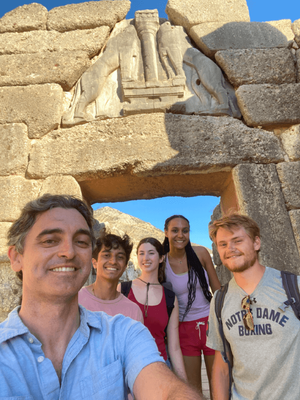
<p>This summer, four students from the University of Notre Dame—Nathan McLeod, Esther Prantil-Evans, Neel Gupta, and Ruth Halperin—spent three unforgettable weeks at the archaeological site and museum of Isthmia in the Corinthia, Greece.</p>
<p>Under the direction of Prof. Alessandro Pierattini, and as part of a joint Architecture and Classics internship, they worked hands-on with artifacts over 2,500 years old—learning conservation techniques on bronze armor, Corinthian ceramics, sculpture, inscriptions, coins, and more. On site, they helped document the Archaic Temple of Poseidon—one of the earliest stone temples of Greek architecture!</p>
<p>The experience also included guided visits to major archaeological sites and museums across the Corinthia and the Peloponnese. Pictured here, among other moments, our students explore Mycenae, legendary home of King Agamemnon, standing at the Lion Gate and in front of the so-called Treasury of Atreus.</p>
<p>A life-changing dive into ancient history, architecture, and heritage preservation—on the ground in Greece!</p>]]>
    </content>
    <link rel="enclosure" type="image/jpeg" href="https://classics.nd.edu/assets/633240/summer_2025_internship_greece_featired_image.jpg" title="Five smiling people, including a man and four students, take a selfie in front of ancient stone ruins under a bright blue sky. One student wears a grey &quot;Notre Dame Boxing&quot; t-shirt."/>
    <author>
      <name>Chelsea Cloutier</name>
    </author>
  </entry>
  <entry>
    <id>tag:classics.nd.edu,2005:News/173383</id>
    <published>2025-06-18T14:14:00-04:00</published>
    <updated>2025-10-08T09:55:39-04:00</updated>
    <link rel="alternate" type="text/html" href="https://classics.nd.edu/news-events/news/chair-of-the-department-of-classics-book-review-in-the-wall-street-journal/"/>
    <title>Classics department chair's latest book reviewed by the Wall Street Journal</title>
    <summary type="text">
      <![CDATA[&quot;Grillo’s thoughtful selections and lucid translations are accompanied…]]>
    </summary>
    <content type="html">
      <![CDATA[<figure class="image image-left"><img src="https://classics.nd.edu/assets/571249/200x/how_to_make_money.jpg" alt="Photo of the book. It features the title and a photo of a carving of a man counting coins and holding a book." width="200" height="306"></figure>
<p>"Grillo’s thoughtful selections and lucid translations are accompanied by the original Greek and Latin texts as well as his informative commentary. . . . I never thought I’d be able to combine my career in Latin with my growing interest in finance and investing. Then again, I never thought I’d be interested in the difference between a 401(k) and a 403(b)."—Daniel Gallagher, <em>Wall Street Journal </em></p>
<p><a href="https://www.wsj.com/arts-culture/books/how-to-make-money-review-imperial-investments-d35c7da2?mod=arts-culture_lead_pos1">Read full article.</a></p>
<p>The book uncovers the surprising financial world of ancient Rome, revealing how concepts of investment, banking, and social mobility were surprisingly present even two millennia ago. Professor Grillo blends fascinating historical anecdotes with original Latin and Greek texts, showcasing both the ambitions and contradictions of Roman wealth management. Discover that the pursuit and complexities of money are truly timeless, making this an essential read for anyone intrigued by the intersection of history and personal finance.</p>]]>
    </content>
    <link rel="enclosure" type="image/jpeg" href="https://classics.nd.edu/assets/629965/luca_grillo_headshot.jpg" title="L.Grillo Headshot"/>
    <author>
      <name>Chelsea Cloutier</name>
    </author>
  </entry>
  <entry>
    <id>tag:classics.nd.edu,2005:News/169496</id>
    <published>2025-01-24T09:55:00-05:00</published>
    <updated>2025-10-03T22:06:10-04:00</updated>
    <link rel="alternate" type="text/html" href="https://classics.nd.edu/news-events/news/summer-internship-experience-in-rome/"/>
    <title>Summer Internship Experience in Rome</title>
    <summary type="text">
      <![CDATA[Two Classics majors and another Notre Dame intern worked for six weeks this summer as manuscript transcription interns at Pontifical Gregorian University in Rome. Using the GATE digital system, we transcribed the c. 1650 108-page Latin manuscript Dialogus…]]>
    </summary>
    <content type="html">
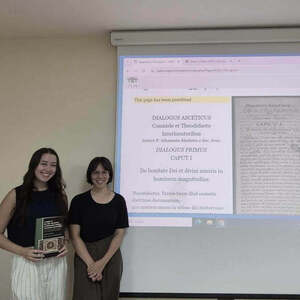
      <![CDATA[<p>Two Classics majors and another Notre Dame intern worked for six weeks this summer as manuscript transcription interns at Pontifical Gregorian University in Rome. Using the GATE digital system, we transcribed the c. 1650 108-page Latin manuscript <a href="https://gate.unigre.it/mediawiki/index.php/AKC_Works_034"><em>Dialogus Asceticus Cosmiele et Theodidacto Interlocutoribus</em></a> by Athanasius Kircher, a Jesuit theologian and polymath. It was startling to discover how much the manuscript preserved a record of the author's thought process. There are places where Kircher, wrestling with a technical theological concept, writes one word, then crosses it out and inserts another above it, then crosses that one out and reverts to the original. There are places where German, Kircher's native language, seems to peek through his Latin: sometimes he writes a verb in position two, then catches himself, crosses it out, and rewrites it at the end of the clause. There are some places where Kircher writes fluidly, and others where his words are so cramped it is difficult not to imagine him hunched over the page in concentration. We tried to preserve these textual foibles in our transcription whenever possible, using basic coding to indicate crossed out words, insertions, and marginal text. After finishing the transcription, we went on to read the manuscript and compose for each section English abstracts to help future researchers navigate the document.</p>
<p><img src="https://classics.nd.edu/assets/602073/300x/image.jpg" alt="" width="300" height="300"></p>]]>
    </content>
    <link rel="enclosure" type="image/jpeg" href="https://classics.nd.edu/assets/633411/image.jpg" title="Two smiling women stand before a presentation screen showing academic text. One woman wears a dark top and striped pants, holding a green book. The other wears a dark top."/>
    <author>
      <name>Jane Hahn</name>
    </author>
  </entry>
  <entry>
    <id>tag:classics.nd.edu,2005:News/169175</id>
    <published>2025-01-10T11:09:41-05:00</published>
    <updated>2025-01-10T12:49:33-05:00</updated>
    <link rel="alternate" type="text/html" href="https://classics.nd.edu/news-events/news/chair-of-the-department-of-classics-to-present-recent-publication-in-new-york/"/>
    <title>Chair of the Department of Classics to Present Recent Publication in New York</title>
    <summary type="text">
      <![CDATA[Department Chair, Professor Luca Grillo, will present his new book &quot;How to Make Money&quot; in Manhattan, NY.]]>
    </summary>
    <content type="html">
      <![CDATA[<figure class="image image-left"><img src="https://classics.nd.edu/assets/288457/300x/luca_grillo.jpg" alt="Luca Grillo" width="300" height="375">
<figcaption>Luca Grillo professional headshot</figcaption>
</figure>
<p>Department Chair, Professor Luca Grillo, will present his new book "<a href="https://press.princeton.edu/books/hardcover/9780691239125/how-to-make-money">How to Make Money</a>" in Manhattan, NY. The event is organized by the Paideia Institute and sponsored by Citco Financial Group and Princeton University Press.</p>
<p>For more information, please see the <a href="https://www.paideiainstitute.org/how_to_make_money">Paideia Institute's website</a>.</p>]]>
    </content>
    <author>
      <name>Chelsea Cloutier</name>
    </author>
  </entry>
  <entry>
    <id>tag:classics.nd.edu,2005:News/168696</id>
    <published>2024-12-06T09:29:00-05:00</published>
    <updated>2025-10-03T22:16:32-04:00</updated>
    <link rel="alternate" type="text/html" href="https://classics.nd.edu/news-events/news/classics-department-awarded-a-democracy-initiative-grant/"/>
    <title>Classics Department Awarded a Democracy Initiative Grant</title>
    <summary type="text">
      <![CDATA[Luca Grillo and the Medieval Institute will conduct a project on &quot;Religion, Power, Democracy: The Deep Roots of the Modern Paradigm,&quot; which will investigate the 11th-12th century revolution sparked by the Investiture Controversy, which reevaluated democracy and influenced the formation of modern states.]]>
    </summary>
    <content type="html">
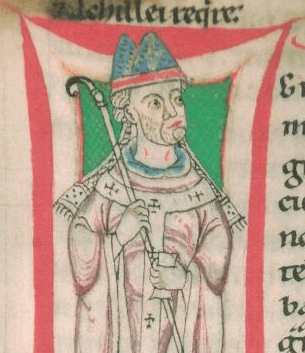
      <![CDATA[<figure class="image image-left"><img src="https://classics.nd.edu/assets/597124/image_11_.png" alt="Medieval illustration of a bishop, likely from a manuscript. He wears a mitre and holds a crosier, a stylized shepherd's crook. He's depicted against a green background with red and white vertical borders." width="305" height="353">
<figcaption>Medieval Illustration of Pope Gregory VII.</figcaption>
</figure>
<p>Luca Grillo and the Medieval Institute will conduct a project on "Religion, Power, Democracy: The Deep Roots of the Modern Paradigm," which will investigate the 11th-12th century revolution sparked by the Investiture Controversy, which reevaluated democracy and influenced the formation of modern states. Through two interdisciplinary workshops in 2025 and 2026, Notre Dame scholars will explore the cultural, political, and theological conditions of this transformation and its impact on modern statehood. The initiative will feature Prof. Marco Rainini, a leading expert on the era, who will deliver preparatory lectures and participate in the workshops, engaging faculty and students across disciplines.</p>
<p>Notre Dame publicly <a href="https://strategicframework.nd.edu/news/notre-dame-launches-university-wide-democracy-initiative-to-advance-research-education-and-policy-efforts-to-sustain-and-enhance-democracy/">launched its University-wide Democracy Initiative</a> in April 2024, followed by May's inaugural <a href="https://kellogg.nd.edu/global-democracy-conference-2024#:~:text=May%2020%20to%2022%2C%202024&amp;text=With%20the%20theme%20%22Understanding%20Today,of%20democracy%20around%20the%20world.">Global Democracy Conference</a>, hosted by the <a href="https://kellogg.nd.edu/research/major-research-initiatives/kellogg-democracy-initiatives">Kellogg Institute for International Studies</a>, and the second annual <a href="https://rooneycenter.nd.edu/events/keeping-the-republic-conference/">Keeping The Republic conference</a> (focused on democracy in the U.S.), hosted by the <a href="https://rooneycenter.nd.edu/">Rooney Center for the Study of American Democracy</a>.</p>
<p>After a University-wide <a href="https://strategicframework.nd.edu/initiatives/democracy-initiative/democracy-initiative-funding-opportunity/">call for Democracy Catalyst Funding proposals</a>, in November the Initiative <a href="https://strategicframework.nd.edu/news/democracy-initiative-awards-40-democracy-catalyst-grants-to-projects-across-campus/">awarded funding to 40 research, education, and convening projects</a> led by 70 scholars representing colleges, schools, centers, and institutes across campus and across the disciplines.</p>]]>
    </content>
    <link rel="enclosure" type="image/jpeg" href="https://classics.nd.edu/assets/633413/image.jpg" title="Medieval illumination of a bearded cleric wearing a blue and red mitre, a white robe with cross symbols, and a blue collar. He holds a silver crozier against a green background with red and white borders."/>
    <author>
      <name>Chelsea Cloutier</name>
    </author>
  </entry>
  <entry>
    <id>tag:classics.nd.edu,2005:News/167565</id>
    <published>2024-10-16T14:04:35-04:00</published>
    <updated>2024-10-17T16:32:10-04:00</updated>
    <link rel="alternate" type="text/html" href="https://classics.nd.edu/news-events/news/applications-open-for-summer-abroad-2025-internships-deadline-friday-october-25-2024/"/>
    <title>Applications Open for Summer Abroad 2025 Internships, deadline: Friday October 25, 2024.</title>
    <summary type="text">
      <![CDATA[Classics Summer 2025 Research Internships: Rome and Isthmia Dear Classics Majors and Minors, We invite you to apply for our fully funded summer internships in Rome and Isthmia, Greece. Our 2024 inaugural summer session was so successful that we are hoping to add even more internship…]]>
    </summary>
    <content type="html">
      <![CDATA[<h2>Classics Summer 2025 Research Internships: Rome and Isthmia</h2>
<p>Dear Classics Majors and Minors,</p>
<p>We invite you to apply for our fully funded summer internships in Rome and Isthmia, Greece. Our 2024 inaugural summer session was so successful that we are hoping to add even more internship opportunities for Summer 2025. The application deadline is <strong>Friday, October 25, 2024.</strong></p>
<h3>Funding</h3>
<p>Interns will receive full funding to cover the costs of insurance, housing, food, miscellaneous expenses, and organized field trips (as available). Funds have been generously provided by the Department of Classics' McNulty Fund, the Nanovic Center, the Rome Global Gateway, and the Center for the Study of Languages and Cultures.</p>
<h3>Eligibility</h3>
<p>Notre Dame Classics majors or minors. Graduating seniors are not eligible.<br>We will consider applications both from Classics majors and minors, but preference will be given to majors.</p>
<h3>Application</h3>
<p>For further information and application steps, please visit the <a href="https://classics.nd.edu/summer-programs/internships/" class="btn btn-lg">internships page</a>.</p>
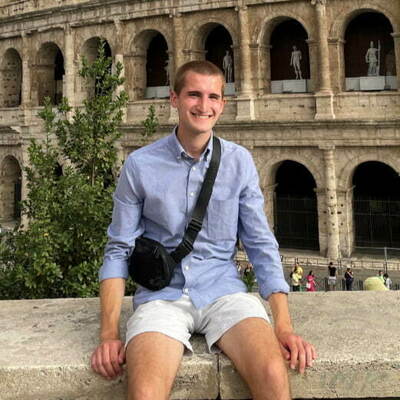
<figure class="image image-left"><img src="https://classics.nd.edu/assets/590860/400x/interns_2.jpg" alt="In his downtime, an undergraduate student sits in from of the colosseum." width="400" height="400"></figure>
<p> </p>]]>
    </content>
    <link rel="enclosure" type="image/jpeg" href="https://classics.nd.edu/assets/590861/interns_3.jpg" title="Three undergraduate men in coordinating blue button-down shirts pause from their work in the archives for a selfie."/>
    <author>
      <name>Chelsea Cloutier</name>
    </author>
  </entry>
  <entry>
    <id>tag:classics.nd.edu,2005:News/166695</id>
    <published>2024-09-18T08:53:00-04:00</published>
    <updated>2025-10-08T10:00:18-04:00</updated>
    <link rel="alternate" type="text/html" href="https://classics.nd.edu/news-events/news/visiting-scholar-gives-two-lectures-on-campus/"/>
    <title>Visiting Scholar Gives Two Lectures on Campus</title>
    <summary type="text">
      <![CDATA[]]>
    </summary>
    <content type="html">
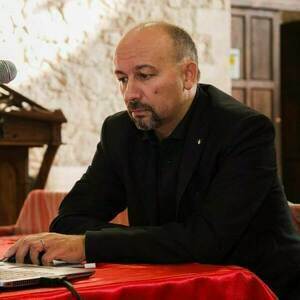
      <![CDATA[<figure class="image image-right"><img src="https://classics.nd.edu/assets/633414/rainini_square.jpg" alt="Man with a short beard and receding hairline in a black suit jacket and dark shirt sits at a red draped table, typing on a laptop. A microphone and a wooden lectern are visible in the blurry background." width="300" height="300"></figure>
<p>Marco Rainini came to Notre Dame as a visiting scholar of Church History from L’Università Cattolica del Sacro Cuore in August and September of 2024. During this period, Professor Rainini worked on his “Critical Edition of Joachim of Fiore.” As part of this arrangement, he gave a series of two lectures on this subject. Both lectures, the first on August 30th and the second on September 5th, were well-attended by students and faculty from the Department of Classics, the Center of Italian Studies, and the Medieval Institute.</p>
<p>In his first lecture, Rainini detailed briefly the biography of Joachim of Fiori (a Cistercian monk from Calabria) who produced textual and visual exegeses of the Bible. By categorizing episodes from the Old and New Testament, Joachim sought to demonstrate that the Old Testament functions as an allegory for the life of Jesus in the New Testament. In other words, to quote St. Augustine, “the New is hidden in the Old, and the Old becomes clear in the New.” In his second lecture, Rainini expanded upon the apocalyptic thinking embedded in Joachim’s work and the reception of that Apocalypticism by later scholars and theologians. Throughout both lectures, Rainini spoke in depth on his methods for incorporating image analysis into his research. In sum, this lecture series was an engaging and enriching start to a promising new school year.</p>]]>
    </content>
    <link rel="enclosure" type="image/jpeg" href="https://classics.nd.edu/assets/633415/rainini_featured.jpg" title="A bald man with a dark beard, wearing a black suit and shirt, sits at a red-covered table, looking down intently. His hands rest on papers in front of him. A microphone and wooden furniture are in the background."/>
    <author>
      <name>Elise Williams and Gizelle Winter</name>
    </author>
  </entry>
  <entry>
    <id>tag:classics.nd.edu,2005:News/163436</id>
    <published>2024-06-18T15:00:24-04:00</published>
    <updated>2024-09-17T09:09:05-04:00</updated>
    <link rel="alternate" type="text/html" href="https://classics.nd.edu/news-events/news/faculty-book-release/"/>
    <title>Faculty Book Release</title>
    <summary type="text">
      <![CDATA[Brian Krostenko has recently published The Voices of the Consul: The Rhetorics of Cicero&#39;s de lege agraria I and II (Oxford, 2024). This is the first book-length study of the rhetoric of two understudied speeches of Cicero, which uses the techniques of discourse analysis to reveal how and why Cicero, at the beginning of his term as one of Rome&#39;s supreme executive officers, lays claim to contested political slogans and ideologies in the turbulent late Republic. Krostenko is a professor of the culture and law of the Late Roman Republic, Cicero, Catullus, rhetoric, and Latin linguistics.]]>
    </summary>
    <content type="html">
      <![CDATA[<figure class="image image-left"><img src="https://classics.nd.edu/assets/571837/voices_cover_krostenko.jpg" alt="The cover of Krostenko's book, includes a bust of Cicero" width="180" height="274"></figure>
<p>Brian Krostenko has recently published <a href="https://global.oup.com/academic/product/the-voices-of-the-consul-9780199734207?cc=us&amp;%20target=" _blank="" data-saferedirecturl="https://www.google.com/url?q=https://global.oup.com/academic/product/the-voices-of-the-consul-9780199734207?cc%3Dus%26lang%3Den%26%23&amp;source=gmail&amp;ust=1718812000942000&amp;usg=AOvVaw32j6hOx2nvF0KAb5_0Wcuo" rel="noopener"><em>The Voices of the Consul: </em></a><a href="https://global.oup.com/academic/product/the-voices-of-the-consul-9780199734207?cc=us&amp;%20target=" _blank="" data-saferedirecturl="https://www.google.com/url?q=https://global.oup.com/academic/product/the-voices-of-the-consul-9780199734207?cc%3Dus%26lang%3Den%26%23&amp;source=gmail&amp;ust=1718812000942000&amp;usg=AOvVaw32j6hOx2nvF0KAb5_0Wcuo" rel="noopener"><em>The Rhetorics of Cicero's </em>de lege agraria <em>I and II</em> (Oxford, 2024)</a>. This is the first book-length study of the rhetoric of two understudied speeches of Cicero, which uses the techniques of discourse analysis to reveal how and why Cicero, at the beginning of his term as one of Rome's supreme executive officers, lays claim to contested political slogans and ideologies in the turbulent late Republic.</p>
<p>Krostenko is a professor of the culture and law of the Late Roman Republic, Cicero, Catullus, rhetoric, and Latin linguistics.</p>]]>
    </content>
    <link rel="enclosure" type="image/jpeg" href="https://classics.nd.edu/assets/571837/voices_cover_krostenko.jpg" title="The cover of Krostenko's book, includes a bust of Cicero"/>
    <author>
      <name>Chelsea Cloutier</name>
    </author>
  </entry>
  <entry>
    <id>tag:classics.nd.edu,2005:News/163207</id>
    <published>2024-06-10T12:06:40-04:00</published>
    <updated>2024-09-17T09:07:57-04:00</updated>
    <link rel="alternate" type="text/html" href="https://classics.nd.edu/news-events/news/classics-professor-releases-a-new-book/"/>
    <title>Classics Professor Releases a New Book</title>
    <summary type="text">
      <![CDATA[Professor Luca Grillo has just released a new book: How to Make Money: An Ancient Guide to Wealth Management. It has been selected by Princeton University Press to be presented with a video at the 2024 Frankfurt Book Fair.How did the Romans make a living? Grillo explores different occupations including the most respected and the most lucrative. This book offers a revealing look at the Romans&#39; world of work and money. Luca Grillo is Professor and Chair of Classics and Arabic, a fellow at the Kellogg Institute, and an Associate Editor of the American Journal of Philology.]]>
    </summary>
    <content type="html">
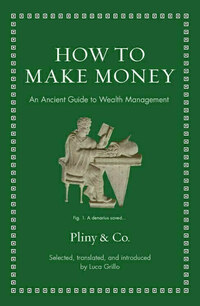
      <![CDATA[<p>Professor Luca Grillo has just released a new book: <em><a href="https://press.princeton.edu/books/hardcover/9780691239125/how-to-make-money">How to Make Money: An Ancient Guide to Wealth Management</a>. It has been selected by Princeton University Press to be presented with a video at the 2024 Frankfurt Book Fair.</em><br><br>How did the Romans make a living? Grillo explores different occupations including the most respected and the most lucrative. This book offers a revealing look at the Romans' world of work and money.</p>
<p>Luca Grillo is Professor and Chair of Classics and Arabic, a fellow at the Kellogg Institute, and an Associate Editor of the <em>American Journal of Philology</em>.<br><br><br></p>
<figure class="image image-left"><img src="https://classics.nd.edu/assets/571249/300x/how_to_make_money.jpg" alt="Photo of the book. It features the title and a photo of a carving of a man counting coins and holding a book." width="300" height="458"></figure>
<p> </p>]]>
    </content>
    <author>
      <name>Chelsea Cloutier</name>
    </author>
  </entry>
  <entry>
    <id>tag:classics.nd.edu,2005:News/161568</id>
    <published>2024-04-26T09:46:00-04:00</published>
    <updated>2024-09-17T09:06:55-04:00</updated>
    <link rel="alternate" type="text/html" href="https://classics.nd.edu/news-events/news/professor-emeritus-publishes-new-book/"/>
    <title>Professor Emeritus Publishes New Book</title>
    <summary type="text">
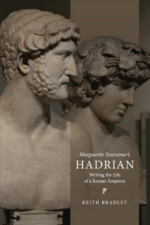
      <![CDATA[Retired Notre Dame Professor of Classics Keith Bradley has released a new book: Marguerite Yourcenar&#39;s Hadrian: Writing the Life of a Roman Emperor. In it, Bradley explains how Yourcenar&#39;s Mémoires d’Hadrien was written, gives details of her life, and describes some of the intricate historical problems that her novel’s portrait of Hadrian presents. Bradley is the Eli J. and Helen Shaheen Professor of Classics Emeritus at the University of Notre Dame and an adjunct professor in the Department of Greek and Roman Studies at the University of Victoria. He is also a Fellow of the Royal Society of Canada.]]>
    </summary>
    <content type="html">
      <![CDATA[<p>Retired Notre Dame Professor of Classics Keith Bradley has released a new book:<em> Marguerite Yourcenar's Hadrian: Writing the Life of a Roman Emperor.</em> In it, Bradley explains how Yourcenar's <em>Mémoires d’Hadrien</em> was written, gives details of her life, and describes some of the intricate historical problems that her novel’s portrait of Hadrian presents.</p>
<p>Bradley is the Eli J. and Helen Shaheen Professor of Classics Emeritus at the University of Notre Dame and an adjunct professor in the Department of Greek and Roman Studies at the University of Victoria. He is also a Fellow of the Royal Society of Canada.</p>
<figure class="image image-left"><img src="https://classics.nd.edu/assets/566748/150x/bradley_book.png" alt="Cover of Professor Bradley's Book, featuring two Classical busts and the title." width="150" height="225"></figure>]]>
    </content>
    <author>
      <name>Department of Classics</name>
    </author>
  </entry>
</feed>