Courses
Have you ever wanted to know what Notre Dame’s motto: Vita, Dulcedo, Spes means? Or the origins of our legal system? Do you love philosophy and want to read Plato’s Apology in its original form?
Look no further than the Classics Department, where you can study Greek and Latin, as well as learn about ancient Greco-Roman culture.
Peruse a selection of some of our most popular courses below. The full offering and descriptions are in PATH Class Search (login required).
Latin:
Early Christian Latin
This class surveys the development of Christian Latin language and literature from their origins through Late Antiquity and the early Middle Ages. It introduces students to the various important linguistic, stylistic and literary influences that contributed to Christian Latin poetry and prose. Students will also be introduced to the varieties of Christian Latin texts and the bibliographical and research skills needed to pursue research into these texts.
Vergil
This third-year course on the Aeneid, Vergil's literary masterpiece written in Rome in the last decades of the first century BC, aims to develop students' skills in: translating Latin poetry; reading aloud and analyzing Latin hexameters; analyzing Latin poetic style; interpreting classical epic poetry. Class will consist primarily of close study of assigned passages from the Latin text of the poem. Students will also read the entire poem in English translation and consider its cultural and historical context. The course prepares students for advanced study in Latin language and literature.
Seneca and Stoicism
This advanced course in Latin on the writings of the Roman Stoic philosopher Seneca (aka Seneca the Younger, 4BCE- 65CE) will focus on Seneca’s letters, and then on his essay De Ira "On Anger". We will read selections of other dialogues of his in English, as well some recent critical commentary on Seneca’s work. Students will learn to read Seneca’s Latin and to recognize the particular characteristics of his style as a means to learning Seneca’s philosophical outlook, and thinking about it critically. We will also read a couple of his plays in English to consider what this philosopher does when he takes his philosophy to literature.
Latin Love Elegy
This course introduces students to the genre of Latin Love Elegy through close reading of the poetry of Propertius and Ovid. We will be concerned mainly with the practice of translation, analysis of poetic meter and style, and literary interpretation. However, our work will also involve examination of the socio-political conditions in Rome in the late 1st c. BC that provided an essential context for the development of the genre. Related to this, we will be paying close attention to the ways in which Roman elegy constructs gender and how it defines itself in relation to other genres, especially epic. In addition to daily translation assignments, students will recite selected poems to the class, take two semester exams and a final exam and write an essay of 5-6 pages.
Greek:
Herodotus
Herodotus has been called both the "Father of History" and the father of lies. His Histories, written in the second half of the fifth century BCE, is one of our earliest fully-surviving Greek prose texts and our most important source for the Greco-Persian Wars. But Herodotus offers so much more than political and military narrative: ethnography, geography, religious history, political theory, rhetoric, and a welter of short stories, all delivered by a master storyteller. In this advanced Greek course, we will read a selected book of the Histories in Greek, as well as the entire work in English and a selection of modern scholarship. We will consider the historical and intellectual context, questions of genre and prose style, and the tradition of historical writing begun by Herodotus and his work.
Homer
Homer's epic poems stand at the head of the tradition of European literature; their themes and poetic style have substantially influenced the works of Dante, Milton, and many other European writers. This advanced Greek course offers close readings of passages from the Iliad and Odyssey. The selection of texts will vary with every iteration of the course. In addition to reading the Greek texts, we will discuss the poems in their historical, cultural, linguistic and literary context, and reflect on aspects of Greek religion, Greek warfare and the place of men and women in Greek society.
Greek Texts in the Roman and Judeo-Christian Worlds
This course offers readings in a wide variety of Greek texts from the Hellenistic and Roman imperial periods. It is designed to build upon Intermediate Greek, further improving students' knowledge of Greek vocabulary, morphology, and syntax. After completing this course students will have reached an advanced level of reading proficiency in ancient Greek. Authors to be read include, among others, Philo, Josephus, Plutarch, Pausanias, Lucian, Dio Chrysostom, Clement of Alexandria, Origen, Eusebius, Julian, and Libanius. Books of the Septuagint and the New Testament may also be read. The aim of the course is to show students the literary culture in which Judeo-Christian literature developed and of which it came to form a part. This course may fulfill the Greek requirement for graduate students in Theology. Please consult your advisor.
Classical Civilization:
Old Money: Roman Coins and Roman History
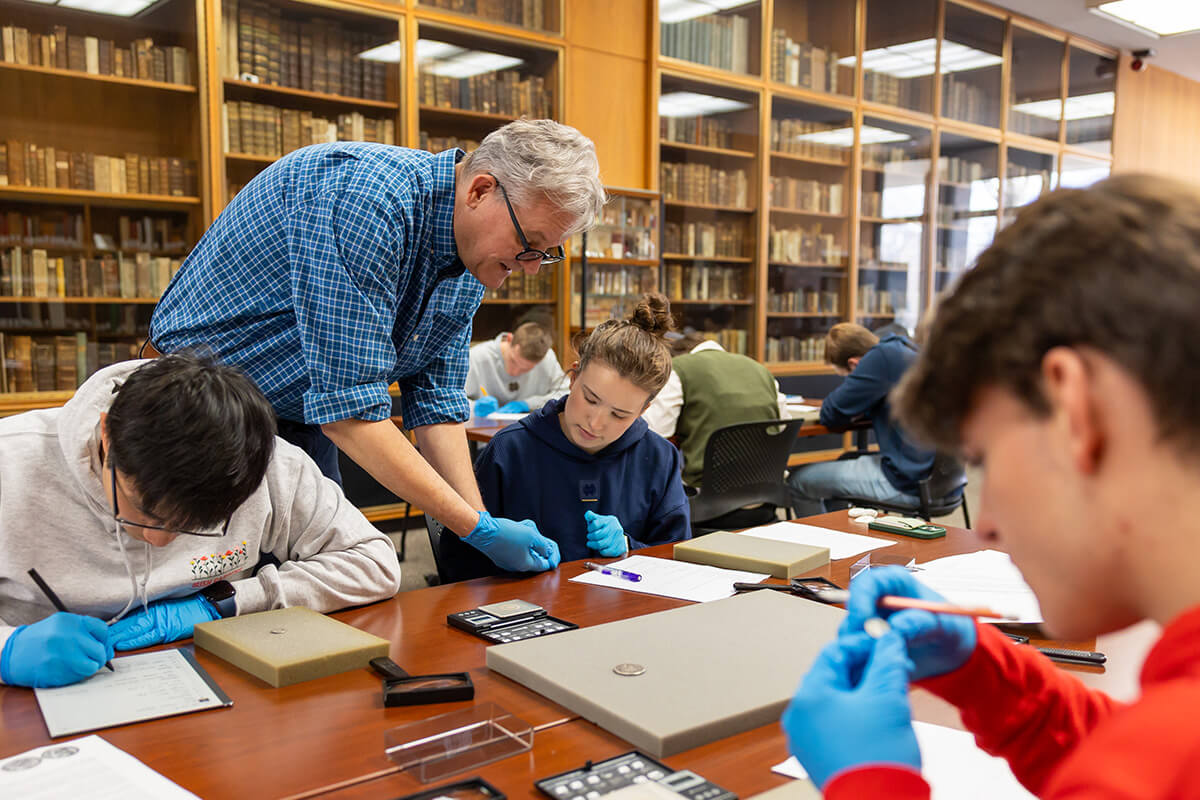
This course introduces students to the study of ancient Roman coins, focusing on their use as historical sources and the insights they provide into Roman society, economy, and politics. By examining the production, iconography, and use of Roman coinage, students learn how coins served as tools for propaganda, economic stability, and cultural expression. The course also includes practical sessions where students will work with a collection of Roman coins in the Hesburgh Library to develop skills in numismatic analysis and to closely examine some specimens for the first time. For the final project, students will research a specific coin from our collection and present their findings.
Archaeology of Imperial Rome: Caesar to Constantine
This course examines the archaeology of the Rome Empire, from the rise of Julius Caesar to the reign of Constantine. Students analyze and interpret material evidence from the ancient Roman world, from both Italy and the provinces, and assess the multi-faceted histories and cultures of the Roman people. The aim of the course is to introduce students to the analysis and interpretation of Roman material culture, particularly archaeological sites, monuments and art. The course traces the formation and development of the Roman Empire across the Mediterranean, beginning with the "Golden Age" of Augustus, and attempts to reconstruct what life might have been like in ancient Rome, Pompeii and in the Roman provinces, particularly Roman Greece. In addition to exploring architecture, coins, inscriptions, sculpture, paintings, ceramics and other ancient material, students also consider the methods, results, and theory of archaeological research, in the areas of field excavation and intensive surface survey. Major themes to be discussed include Roman imperialism, acculturation (especially so-called "Romanization"), ethnicity, urbanism, government, paganism, the imperial cult (emperor worship), death and burial, Christianity, and the discrepant identities of women, children, slaves, freedmen, and freeborn under imperial Rome.
The Age of Alexander
This course examines the military achievements of Alexander of Macedon (356-323B.C.) and their far-reaching political, social, cultural, and religious consequences. Topics covered include the Greek, Macedonian, Persian, and other cultural contexts of the time, Alexander's attitude toward divinity (including his own), his concept of empire, his generalship, and his legacy for Greco-Roman antiquity. Particular attention is devoted to representations of Alexander through the ages, beginning during his own lifetime with the accounts of ancient writers "historians and others" down to novels and films of the present day. Ancient authors and documents are read in translation.
Rebels in Myth: From Antigone to the Joker
Be content with what you have! Accept your human and social limits, and never try to overcome them! In their attempt to create a peaceful world (cosmos), ancient Greeks put a high premium on humans' acceptance of their natural condition. Those who asked for more were deemed guilty; their arrogance (hubris) was condemned and punished by the gods. Did ancient Greeks succeed in creating this peaceful world? Many scholars say yes; this course will say no. Ancient Greece is filled with stories of rebels who challenge the established order, and, despite being condemned by their societies, subtly win admiration.
Prometheus disobeys the gods to provide mankind with fire. Antigone and Medea blame the male-centric Athenian society for not giving a voice to women and foreigners. Plato condemns his contemporaries for failing to be interested in the truth. Through their lives and suffering, these rebels were making an important statement: We are unhappy with what we have! We want more, and we are not ashamed to say this! The voice of these ancient rebels still resonates today. In this class, the discussion of Prometheus, Antigone and Plato will be combined with modern and contemporary renderings of their myths, from Shelley's Frankenstein and Scott's 2012 Prometheus to cinematic re-makings of Plato's myth of the Cave, such as The Truman Show, Inception and the TV-series Chernobyl.
The final classes will be devoted to recent movies about the Joker, the famous rebel from DC Comics. In this way, we will discover how myth serves as an expression of human rebellion and desire across different eras.
Eternal Rome: The Archaeology and History of the Ancient City
Two thousand years ago, Rome was the capital of an empire stretching across the Mediterranean, from England, Spain and North Africa to Turkey, Iraq and Egypt. Built from the wealth of its expansive dominion, it was the greatest metropolis on earth, at the center of a vast web of interconnected regions and cultures. The city has remained the focus of the Catholic Church and Christianity in Europe for more than 1500 years. Since antiquity, Rome has welcomed many of the world's greatest intellectuals, artists, and historical figures. Once at the heart of the Italian Renaissance and now capital of Italy, Rome remains preeminent in the world.
This course explores the art, archaeology, history, literature, and urban development of the eternal city, from its legendary Trojan origins to modern times, a period which spans almost three thousand years. The course provides a comprehensive survey of Rome, primarily through the examination of its history and material culture (e.g., architecture, inscriptions, paintings, coins, etc.). We will explore the major archaeological sites and museums, to examine how Rome's monuments and artifacts reflect the social, political, and religious outlook of Roman society over time.
As the largest archaeological site in the world, Rome offers an unparalleled insight into the genesis and development of Europe'its history, art, architecture, literature, philosophies, institutions, and heritage'and thereby provides a deeper glimpse of humanity.